
Last Updated: November 4, 2026
Quick Summary
Online therapy for teens can work, especially cognitive behavioral therapy delivered by video for anxiety and depression, but it is not a universal yes or no. Results depend on the teen, the condition, and the fit with the therapist, and most positive trials involve a licensed clinician rather than a self-guided app.
- A 2016 study found 72% of adolescents said they would access online therapy if they needed support.
- Most positive trials test therapist-supported treatment, not self-guided apps or chatbots alone.
- Severe depression, substance use, and active suicidal ideation are often excluded from online therapy studies.
- Ask which state the therapist is licensed in and how that state handles minor consent before the first session.
- For immediate danger, call or text 988 or go to the nearest emergency room instead of waiting for a session.
Table of Contents
- Is Online Therapy Effective for Teenagers? What the Research Says
- Online Therapy for Teen Anxiety
- Online Therapy for Teen Depression
- Online vs. In-Person Therapy for Teens
- Privacy, Consent, and Confidentiality for Teen Clients
- How to Start Online Therapy: A Step-by-Step Guide
- Crisis Situations and the Limits of Online Care
- Verify Insurance and Get Started with Utah Family Therapy
- Frequently Asked Questions
Is Online Therapy Effective for Teenagers? What the Research Says
Online therapy for teens can work, and the evidence base is stronger than most parents expect. A 2016 study of adolescents found that 72% said they would access online therapy if they needed support, which tells us teens are open to it (adolescent perceptions of online therapy(https://pmc.ncbi.nlm.nih.gov/articles/PMC6371200/)).
Here is what matters most before you scroll: online therapy for teens is not a universal yes or no. It depends on the teen, the condition, and the fit with the therapist.
What the Evidence Shows About Effectiveness
The strongest evidence for teen teletherapy comes from cognitive behavioral therapy delivered by video for anxiety and depression. Researchers who compared online therapy with in-person therapy found that results may depend on trust, willingness to participate, age, and gender (comparison of online and in-person therapy(https://pmc.ncbi.nlm.nih.gov/articles/PMC12772077/)).
A useful way to read the research is by condition, not by headline:
- Anxiety: Research on internet-delivered CBT for adolescents with anxiety disorders has been mixed and varies across studies. Most trials include therapist support, not fully self-guided apps.
- Depression: Some studies of internet-delivered treatment for mild to moderate teen depression report benefits, though results vary. Severe depression is often excluded from these studies, which is why clinicians typically recommend closer monitoring or higher levels of care for severe presentations.
- Obsessive-compulsive disorder and related conditions: Exposure and response prevention can be delivered over video with a coach, but it requires a therapist trained in ERP and a teen willing to do exposures at home.
That 2025 comparison did not hand down a single verdict that virtual care beats face-to-face care for every teen. It pointed to something more useful. Engagement and fit drive outcomes.
What the Research Does Not Tell You
The research is thinner than many headlines suggest. Many trials are small, short, and exclude teens with severe symptoms, substance use, or active suicidal ideation. Be careful with anyone who promises a guarantee.
What we can say with confidence:
- Teens value the accessibility of virtual care
- Stigma is a real barrier that online formats can lower
- Fit and willingness matter as much as the platform
Watch out: a common mistake is treating a self-guided mental health app as equivalent to online therapy. Most positive trials involve a licensed clinician delivering a structured treatment, not a chatbot or a mood-tracking app alone.
How to Read a Study Before You Trust It
When you see a headline claiming online therapy “works” or “doesn’t work” for teens, check four things:
- Who was in the study? Age range, diagnosis, and severity matter. A trial of 13-to-17-year-olds with mild anxiety does not tell you about a 16-year-old with severe depression.
- What was the comparison? Was it compared with in-person therapy, a waitlist, or treatment as usual? Waitlist comparisons inflate the apparent effect.
- Was a therapist involved? Fully self-guided programs usually show smaller effects than therapist-supported ones.
- How long did the follow-up last? A 12-week result is not the same as a one-year result.
If a provider cannot explain which treatments they use and why, that is a signal to ask more questions before booking.
Online Therapy for Teen Anxiety
Online therapy can be a good fit for some adolescents with anxiety. Anxiety often makes leaving the house feel enormous. A video session removes the commute and the waiting room.
How Virtual Sessions Address Anxiety
Cognitive behavioral therapy can be delivered over video. Our teletherapy for anxiety and depression page explains how this works.
The home setting has a hidden benefit. Teens practice calming skills right where their anxiety shows up, not in a strange office.
If your teen is dealing with ongoing anxiety, our Anxiety treatment page describes our approach to anxiety care.
Online Therapy for Teen Depression
Online therapy for teen depression may help some teens. Depression can reduce motivation, so keeping a teen engaged is often a key challenge.
Why Depression May Need a Different Approach
A teen with depression may struggle to show up, let alone open up. For some teens, virtual sessions may lower the effort it takes to attend.
Severe depression needs careful oversight. Our depression treatment page shows how the practice handles teen depression. If symptoms are serious, a clinician may recommend a higher level of care. Our Depression counseling page describes our depression services.
Online vs. In-Person Therapy for Teens
Online vs. in-person therapy for teens is not a winner-take-all contest. Each format has strengths, and the right choice depends on your child.
Here is how the two compare:
| Factor | Online Therapy | In-Person Therapy |
|---|---|---|
| Access | No commute, flexible slots | Travel required |
| Comfort | Familiar home setting | Neutral office space |
| Crisis support | Limited to remote response | Immediate hands-on help |
| Privacy | Needs a private room | Built-in confidentiality |
| Engagement | Strong for willing teens | Strong for hands-on care |
When In-Person Care Is the Better Choice
In-person care may be the better choice in a few situations:
- A teen in active crisis who needs immediate support
- Severe symptoms that need close monitoring
- A teen who simply will not engage on a screen
A common mistake is assuming one format fits every teen. It does not.
Privacy, Consent, and Confidentiality for Teen Clients
Privacy is where online therapy for teens gets complicated. A teen needs a private space to talk freely. A parent needs to know their child is safe. Both can be true. The key is setting ground rules before the first session, and understanding that the rules are not the same everywhere.
VERIFY INSURANCE & GET STARTED →
Consent Rules Depend on Where You Live
Many states allow a minor to consent to their own outpatient mental health treatment at some age, but the specifics vary and should be checked with the official source for your state.
What this means in practice:
- Ask the therapist, before the first session, which state they are licensed in and how that state handles minor consent.
- Ask whether the teen can consent to their own treatment, or whether a parent or guardian must sign.
- Ask what the parent will be told and what stays between the teen and therapist.
Never assume. A therapist licensed in one state may not be able to treat a teen who is physically in another state at the time of the session, which matters for college students and families who travel.
What Parents Can and Cannot Access
In most states, once a minor can consent to their own mental health treatment, the parent does not automatically get access to the therapy records. That can surprise parents who are paying the bill.
The common safety exceptions, which every therapist should explain up front, include:
- Risk of harm to self or others
- Suspected abuse or neglect of a minor, which triggers mandatory reporting
- A court order
Beyond those, the therapist generally cannot tell a parent what the teen said in session without the teen’s permission. Many therapists handle this by agreeing with the teen on what will be shared with parents, for example, general progress updates rather than session content.
Setting Up Privacy for Video Sessions
A teen needs a room where they cannot be overheard and where no one walks in. That is harder than it sounds in a small house.
What to sort out up front:
- Which room the teen will use, and who stays out
- Whether headphones are needed so the conversation is not audible in the next room
- What parents will and will not be told
Watch out: a parent listening from the next room, or asking the teen to put the session on speaker, undermines the therapy and may violate the confidentiality the therapist is obligated to protect.
Platform and Data Privacy
Therapy platforms handle sensitive health information, so ask whether the practice uses a HIPAA-compliant video platform and how messages, notes, and payment records are stored. Ask directly: “Is the video platform HIPAA-compliant, and do you have a business associate agreement with the vendor?”
When Safety Concerns Require Disclosure
Confidentiality is not absolute, and teens should know that before they start. If a therapist believes a teen is at imminent risk of suicide, is harming someone, or is being abused, the therapist is required or permitted to break confidentiality to keep the teen safe. Explaining this at the start builds trust rather than breaking it, teens are more likely to disclose risk when they understand the limits in advance.
How to Start Online Therapy: A Step-by-Step Guide
Starting online therapy for teens may take some preparation. Here are steps families can consider.
- Name the concern. Write down what you are seeing: sleep changes, withdrawal, grades, mood.
- Check the fit. Confirm the therapist works with teens and treats your child’s specific issue.
- Verify credentials. Ask about licensure and experience with adolescents.
- Set up the space. Pick a private room with a reliable connection.
- Agree on privacy rules. Decide what parents will be told.
- Confirm coverage. Check insurance before the first session.
- Book and prepare. Help your teen write down what they want to discuss.
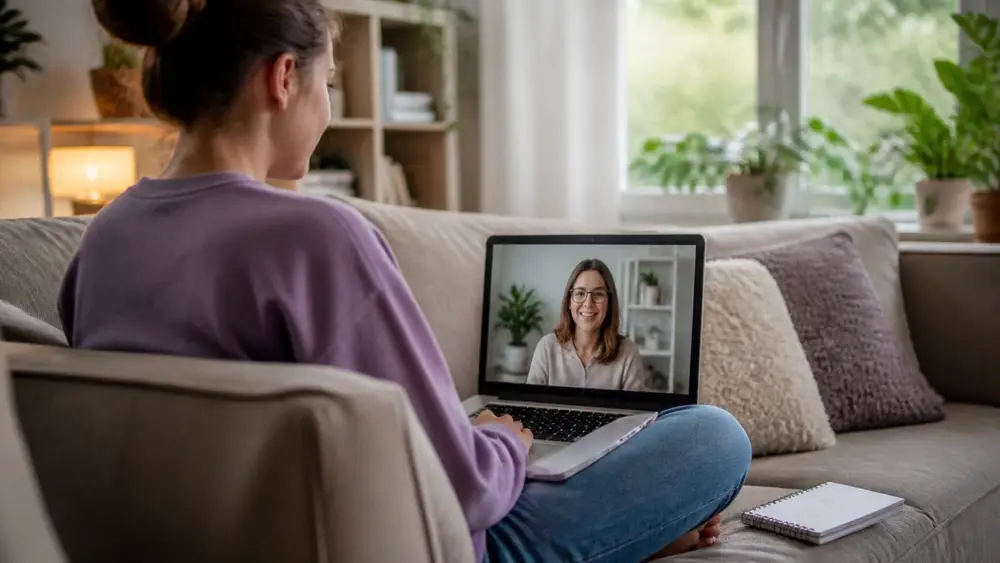
The girl is American.
Crisis Situations and the Limits of Online Care
Online care has real limits. Our immediate mental health support page shows where to turn right now.
Call or text 988, the Suicide and Crisis Lifeline, or go to the nearest emergency room. Do not wait for a scheduled session.
For non-emergency needs, please contact the practice directly to ask about current availability. Knowing the limits ahead of time keeps everyone safer.
Verify Insurance and Get Started with Utah Family Therapy
The best way to know if online therapy for teens works is to try it with the right clinician. At Utah Family Therapy, our clinicians combine professional training with lived experience.
Before you book, verify your insurance coverage. Visit our contact page to reach the practice and book. Use VERIFY INSURANCE & GET STARTED to check openings and get started.
Frequently Asked Questions
Does online therapy actually work for teens?
Research suggests it can. Research suggests many adolescents would access online therapy if they needed support, and they value its accessibility and reduced stigma. A 2025 comparison of online and in-person therapy reported that effectiveness may depend on factors like trust, willingness to participate, age, and gender. Online therapy for teens works best when the teen is engaged and the therapist is a good fit.
What are the downsides of online therapy for teens?
The main drawbacks include limited ability to observe body language and surroundings, potential distractions at home, and technology issues. Privacy can be a concern if a teen does not have a private space for sessions. Also, online therapy may not be suitable for teens in crisis or those who need intensive in-person support. A 2025 study noted that effectiveness varies with trust and willingness, so fit matters.
Can teenagers talk to an online therapist privately?
Confidentiality for minors varies by state and by provider. In many cases, parents must consent to treatment, but therapists often keep session details private unless there is a safety concern. Teens should ask the therapist directly what will be shared with parents. Ask the therapist directly about their privacy policies and the legal rules that apply in their state.
How can parents tell if online therapy is helping their teen?
Look for gradual changes in mood, sleep, school performance, and communication. Your teen may be more willing to talk about feelings or show reduced anxiety in specific situations. Therapists can provide progress updates with the teen’s consent. It’s also important to ask your teen how they feel about the sessions. If there’s no improvement after several weeks, discuss adjusting the treatment plan with the therapist.
The real question is not whether virtual care can work. It is whether it fits your teen. Utah Family Therapy can help you find out, with flexible online and in-person options, insurance acceptance, and clinicians who understand adolescents. Get started with Utah Family Therapy and take the first step toward real support for your child.
